How to Choose a Timing Belt: Profiles, Pitch and Reinforcement
Updated 6 October 2026 · ConveyPro Systems engineering team
In short: For conveying and linear positioning, a PU timing belt in a T or AT profile with steel cords is the usual choice — AT where you need more load and accuracy. For pure power transmission drives, rubber HTD-style belts are common. Always match the profile and pitch to the existing pulleys; tooth shapes are not interchangeable.
Why profile matters
A timing belt transmits motion through teeth meshing with a toothed pulley, so it never slips and the driven shaft stays exactly in step with the motor. The tooth shape (profile) and spacing (pitch) must match the pulley exactly — a T10 belt will not run correctly on an AT10 or an HTD pulley even though the pitch is the same 10 mm. So the first rule is simple: on an existing machine, identify the pulley profile before anything else.
The common profiles compared
Profile
Typical pitches
Tooth shape
Best for
T
T2.5, T5, T10, T20
Trapezoidal (metric)
General conveying and synchronous drives; the most common PU profile
AT
AT3, AT5, AT10, AT20
Trapezoidal, larger and stiffer tooth
Higher loads, better positioning accuracy and less backlash than the same-pitch T profile
HTD / curvilinear
3M, 5M, 8M, 14M
Rounded tooth
Power transmission drives, higher torque; common in rubber belts
Imperial
XL, L, H, XH
Trapezoidal (inch)
Older machines and imported equipment built to inch standards
Choosing the pitch
Larger pitches carry more load but need larger pulleys; smaller pitches run quieter and smoother over small pulleys. As a rough guide, T5/AT5 suit light conveying and small machines, T10/AT10 are the workhorses for most conveyors and linear axes, and T20/AT20 are for heavy loads. Width is then chosen to carry the required pull — doubling the width roughly doubles the load capacity.
Steel or Kevlar reinforcement
Steel cords
Kevlar (aramid) cords
Stretch
Lowest — best for precise positioning
Low
Flexibility
Needs a minimum pulley size
More flexible; suits smaller pulleys and back-bending
Magnetic
Yes
No — use near metal detectors and magnetic sensors
Corrosion
Can corrode if the PU is cut and the belt runs wet
Does not corrode
Typical use
Linear axes, gantries, indexing conveyors
Food lines with metal detection, wet areas, small machines
PU or rubber?
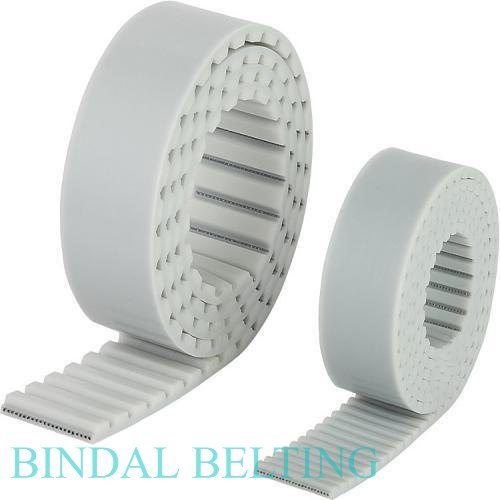
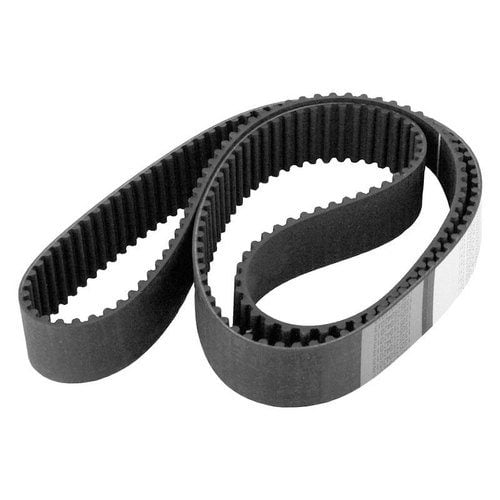
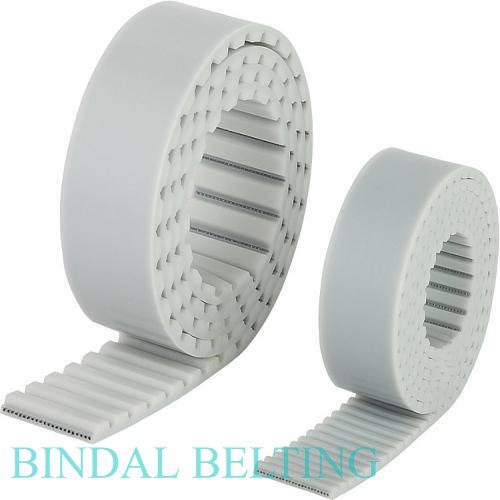
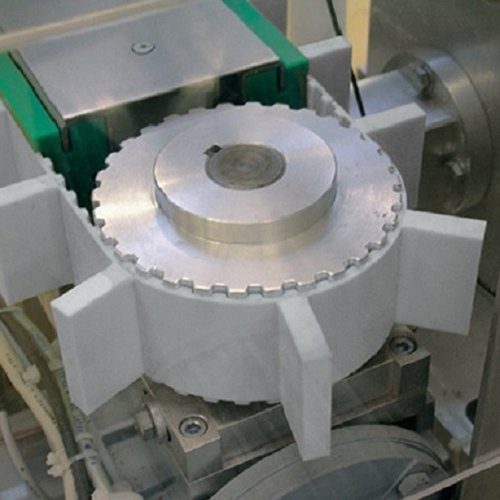
PU timing belts are the standard for conveying and positioning: they resist oils and cleaning agents, can have cleats and special backings welded on, and are available endless, welded or open-ended by the metre. Rubber (neoprene) timing belts are widely used for power transmission: they run quietly, cope with high speeds and shock loads, and are economical in standard lengths.
Endless, welded or open-ended
Endless (seamless): full strength, fixed standard lengths — the first choice for drives
Welded: any length, and easy to add cleats or profiles — but the weld has a lower tensile rating, so check the load
Open-ended by the metre: clamped at both ends for linear actuators, doors, gantries and reciprocating motions
Information needed for a quote
Profile and pitch (or a photo of the tooth next to a ruler), belt width, length or number of teeth (or the pulley centre distance and tooth counts), steel or Kevlar, and any cleats, backing or holes. For a new design, add the load, speed and the space available for pulleys.
Frequently asked questions
No. Although both have a 10 mm pitch, the tooth shapes differ, so the belt will not mesh properly and will wear quickly or jump teeth. Belt and pulley profiles must match.
AT belts have a larger, stiffer tooth that carries more load and gives better positioning accuracy with less backlash than a T belt of the same pitch.
Choose Kevlar where you need a non-magnetic or corrosion-free belt, such as near metal detectors or in wet food lines, or where small pulleys need extra flexibility. Choose steel for the lowest stretch in positioning drives.
Count the teeth and measure the pitch (distance between tooth centres) and width. Note the tooth shape — trapezoidal or rounded — and whether there are steel or Kevlar cords visible at a cut edge.